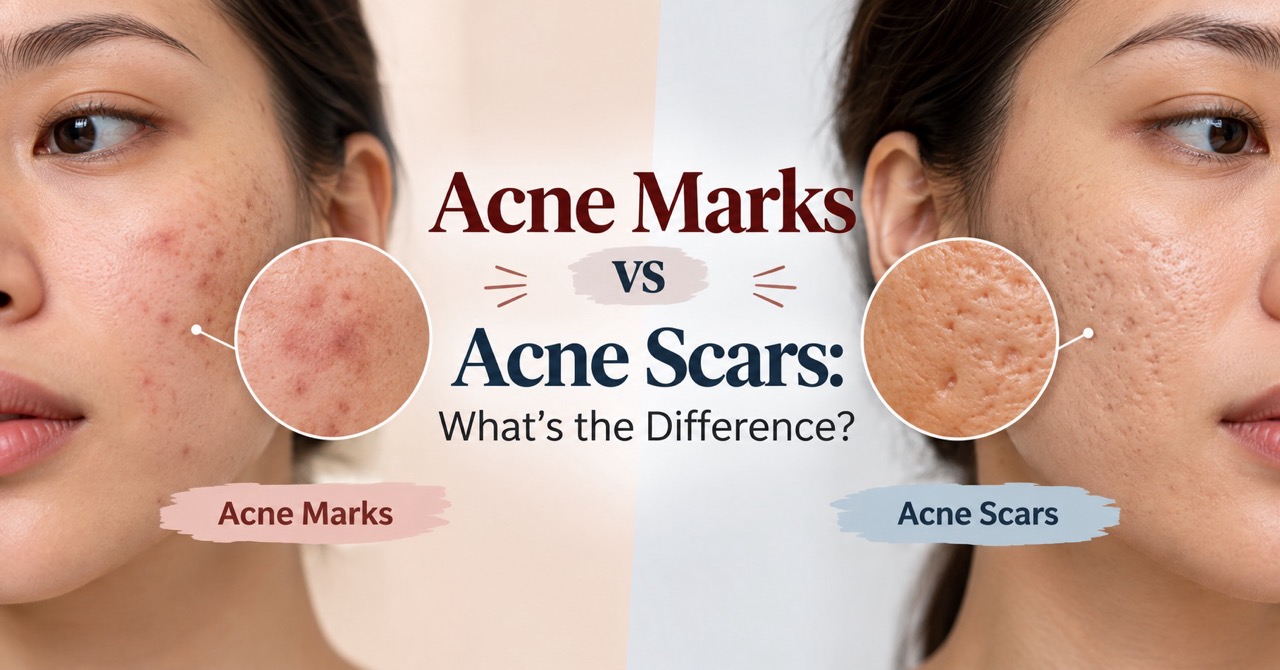
Many people use the terms interchangeably, but understanding acne marks vs acne scars matters for treatment and expectations. Acne marks are changes in skin colour that often improve over time, while acne scars are textural changes in the skin that usually require targeted procedures to improve. This article explains how they differ, how to identify each, typical treatment approaches, and practical prevention tips.
What are acne marks?
Acne marks are post-inflammatory skin colour changes that remain after a pimple heals. They do not alter the skin’s surface texture. The two most common types are:
- Post-inflammatory erythema (PIE): pink or red marks caused by small blood vessels near the skin’s surface. More noticeable on lighter and fair skin tones.
- Post-inflammatory hyperpigmentation (PIH): brown or darker spots caused by excess melanin after inflammation. This tends to be more common and longer-lasting in darker skin tones.
Acne marks form because inflammation from pimples triggers pigment-producing cells or dilates blood vessels. While distressing, marks often fade over weeks to months and are improved by topical and procedural options.
What are acne scars?
Acne scars are permanent or long-lasting changes in skin texture caused by damage to the dermis during a breakout. They affect the surface contour and are generally classified as:
- Atrophic (depressed) scars: include ice-pick (deep and narrow), boxcar (broad with sharp edges), and rolling (wide, shallow waves) scars.
- Hypertrophic and keloid scars: raised, firm scars that occur when the body produces excess collagen during healing. Keloids extend beyond the original injury and are more common on certain body areas and in some skin types.
Scarring indicates structural change under the skin and typically does not resolve without intervention. Treatment aims to remodel tissue and improve appearance, not necessarily to restore completely original skin.
How to tell acne marks vs acne scars apart
- Colour vs texture: Marks are flat and discoloured; scars change the skin’s surface (pits or raised areas).
- Timing: Marks often appear immediately after inflammation and can lighten over weeks–months. Scars become obvious after healing and tend to persist.
- Touch test: Run a fingertip over the area—marks feel smooth, scars feel indented or elevated.
Treatment options — what typically helps
Treatment depends on whether the concern is a mark or a scar. Many approaches require a series of sessions and an assessment to select the most appropriate combination.
Treating acne marks (PIE and PIH)
- Sun protection: Daily broad-spectrum sunscreen helps prevent marks from darkening and supports faster fading.
- Topical therapies: Ingredients such as retinoids, azelaic acid, vitamin C, and chemical exfoliants (AHAs/BHAs) can help accelerate fading of marks over time. Prescription options may be recommended for persistent PIH.
- Procedural options: Superficial chemical peels, light-based therapies, and microneedling with topical agents can speed improvement for stubborn pigmentation. Choice depends on skin type and mark type.
Treating acne scars
- Microneedling: Stimulates collagen production to improve texture for rolling and some boxcar scars.
- Subcision: A minor in-office technique to release tethered scars and improve depressed areas.
- Dermal fillers: Can temporarily lift depressed scars and smooth the surface.
- Laser resurfacing and fractional lasers: Target deeper layers to stimulate remodelling and improve both texture and pigment in some cases.
- Excision or punch techniques: For deep ice-pick or narrow scars, surgical approaches may be combined with other treatments.
- Steroid injections and silicone therapy: Often used for hypertrophic or keloid scars to reduce thickness and flatten raised scars.
Because each scar type responds differently, combined treatments are common. A consultation with a qualified provider can clarify an individualized plan and expected improvements.
Prevention and practical tips
- Avoid picking, squeezing, or popping pimples—mechanical trauma increases the risk of both marks and scars.
- Treat active acne early with appropriate topical or medical therapy to reduce inflammation and the risk of long-term damage.
- Use daily sunscreen to prevent marks from darkening and to protect healing skin after procedures.
- Be patient: marks often fade naturally; scars typically need time and targeted treatment to improve.
When to see a professional
If discolouration is persistent beyond a few months or if texture changes (pits, waves, raised scars) are noticeable, a consultation can help determine appropriate options. In Toronto and North York, cosmetic clinics and dermatology practices offer assessments and combination approaches tailored to skin type and scar pattern. A qualified provider can also advise on realistic expectations and potential risks for your skin.
FAQs
1. How long do acne marks typically last?
Acne marks may fade over several weeks to several months. The exact timeline depends on the type of mark (red vs brown), skin tone, sun exposure, and whether targeted treatment is used.
2. Can acne scars be completely removed?
Complete removal is uncommon, but many scars can be significantly improved. Results vary by scar type, skin characteristics, and the chosen treatments. Multiple modalities are often combined for the best outcome.
3. Should I treat marks at home or see a clinic?
Mild marks can often improve with consistent home care (sunscreen, topical retinoids, gentle exfoliation). For persistent pigmentation or any textural scarring, a professional assessment can identify more effective in-clinic options.
4. Will picking at acne always cause scars?
Picking increases the risk of both pigmentation and scarring because it prolongs inflammation and damages deeper skin layers. Avoid manipulating lesions and seek treatment for inflamed acne when needed.
5. Are some skin types more prone to marks or scars?
Individuals with darker skin tones may be more prone to persistent hyperpigmentation (PIH), and some people have a higher tendency toward hypertrophic or keloid scarring. A provider can recommend safe, effective options tailored to your skin.
To learn whether treatment for acne marks or acne scars may be appropriate for your goals, consider scheduling a consultation with a qualified provider at Perfection Cosmetic Clinic in Toronto / North York. A personalized assessment can help determine which combination of medical-grade topical care and in-clinic procedures may be most suitable.