No products in the cart.

You can get free shipping on any orders over $199. (ORDER NOW)
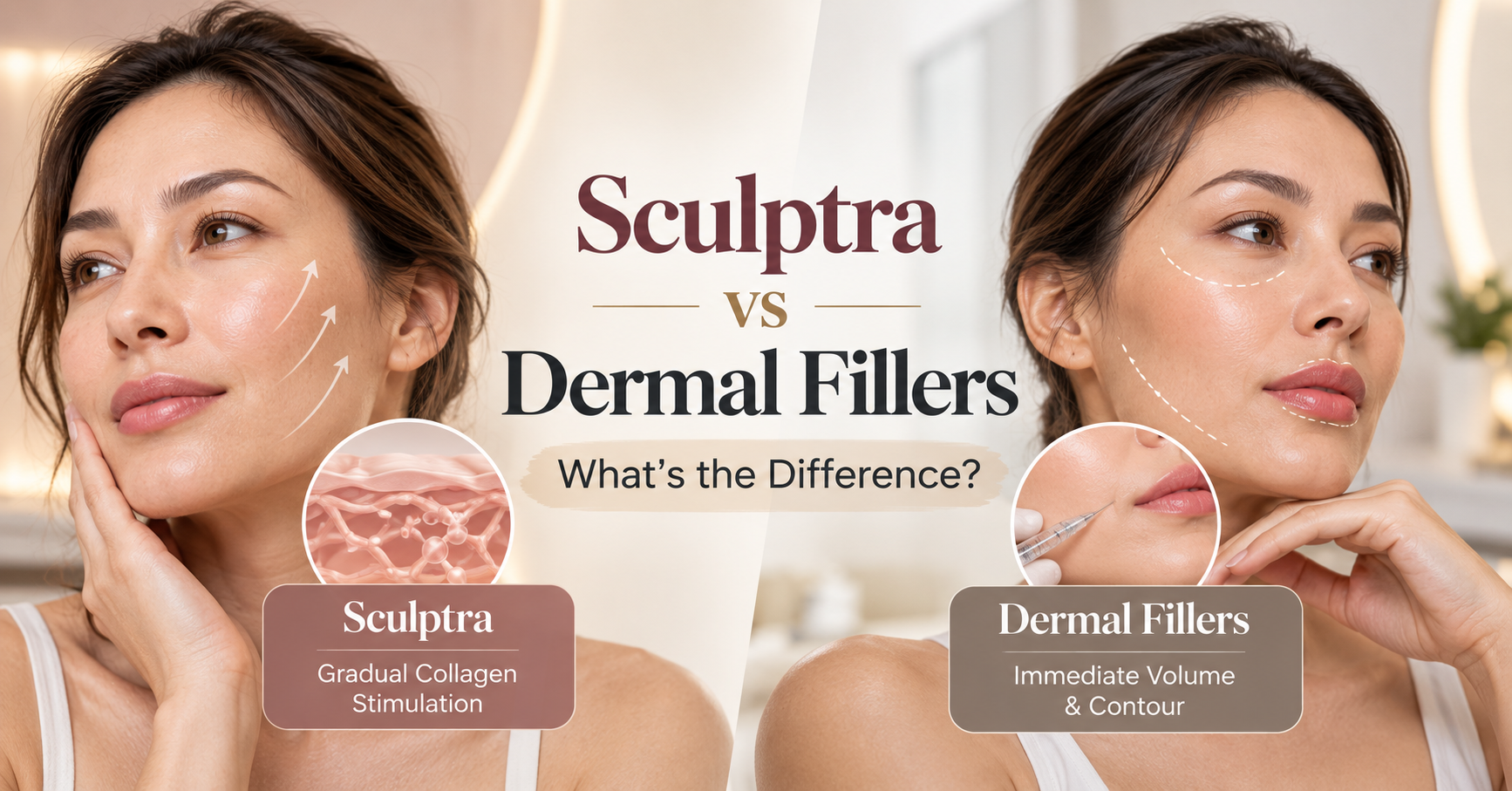
Sculptra vs fillers is a common question for people exploring non-surgical facial rejuvenation. Both approaches can restore lost volume and soften lines, but they work by different mechanisms and suit different goals. Below we explain how Sculptra differs from common dermal fillers, what to expect from each, and how a qualified provider can help determine the best option for your concerns.
Sculptra is a collagen-stimulating treatment whose active ingredient is poly-L-lactic acid (PLLA). Instead of instantly replacing lost volume, Sculptra triggers a controlled tissue response that gradually encourages your skin to produce new collagen. Results develop over weeks to months and can provide more diffuse, long-lasting structural support.
Dermal fillers most commonly refer to hyaluronic acid (HA) fillers, although other products such as calcium hydroxylapatite exist. Fillers add immediate volume and shape by physically occupying space under the skin. Because HA fillers are gel-based, they can produce predictable, immediate changes for areas like the lips, nasolabial folds, and cheek augmentation.
Both approaches can offer extended benefits compared with some temporary options, but longevity varies by product, treatment area, and individual factors such as metabolism and lifestyle.
Both treatments are commonly used and generally well tolerated when administered by experienced providers, but they carry different considerations:
Choosing an experienced, medically trained injector reduces risks and helps achieve predictable results. A consultation can clarify safety considerations based on your medical history and anatomy.
Yes. Many practitioners use a combined approach where Sculptra provides long-term structural support while HA fillers refine specific areas for immediate contour and projection. Sequencing and timing depend on individual goals and treatment planning—your provider will design an approach that balances gradual collagen stimulation with targeted volume where needed.
A thorough consultation at a reputable clinic in Toronto or North York should include a discussion of your aesthetic goals, photographic assessment, review of medical history, and a clear explanation of expected timelines, risks, and alternative options. Your provider may suggest a single approach or a staged plan combining treatments.
Sculptra is classified as a collagen stimulator rather than a volumizing gel filler. It restores volume indirectly by encouraging your body to produce collagen over time.
Fillers typically show immediate results (with some swelling). Sculptra’s effects develop gradually over weeks to months as new collagen forms.
No. Hyaluronic acid fillers can usually be dissolved with hyaluronidase; Sculptra does not have an enzymatic reversal and must be managed conservatively by an experienced injector.
Both have similar short-term side effects—bruising and swelling are common. Downtime tends to be minimal, but individual responses vary. Your provider will advise on aftercare to reduce bruising and swelling.
The better fit depends on your specific concerns, desired timeframe, and priorities such as reversibility. A consultation with a qualified provider can help determine which approach—or combination—best aligns with your goals.
To learn whether Sculptra, dermal fillers, or a combined plan may be appropriate for your facial goals, consider scheduling a consultation with a qualified provider at Perfection Cosmetic Clinic.